
What to Do in Bologna: 18 Best Things to See, Eat and Experience

From UNESCO-listed porticoes and medieval towers to historic markets, traditional osterie and local food traditions: discover the best things to do in Bologna and experience the city beyond the usual tourist attractions

Those planning to visit Bologna often begin by searching for the city’s main attractions, only to discover that its greatest appeal lies in something more: its extraordinary food culture. Bologna is famous around the world for specialties such as tortellini, tagliatelle al ragù, mortadella and Parmigiano Reggiano, earning it the nickname “La Grassa” (The Fat One).

Yet Bologna is far more than a food destination. Visitors quickly fall in love with its endless porticoes, historic shops, lively piazzas and the atmosphere of a city where medieval history, university life and local traditions coexist naturally. This is not a place to rush through in a few hours. To truly appreciate Bologna, you need time to wander, observe and experience everyday life.

What to Do in Bologna: 18 Experiences Spanning Culture, Food and Traditions

While many travel guides present Bologna as a convenient day trip, the city deserves much more than a brief visit. To understand its identity, it is worth exploring not only the major landmarks but also the places where history, gastronomy and local culture have intertwined for centuries.

If you are looking for the best things to do in Bologna, these 18 experiences will help you discover both its famous attractions and its lesser-known side.

Walk Beneath the UNESCO World Heritage Porticoes

No experience captures the spirit of Bologna better than its porticoes. With more than 62 kilometres of covered walkways, they form one of the most remarkable urban landscapes in Europe and have been recognised as a UNESCO World Heritage Site since 2021.

Their arches tell a story spanning nearly a thousand years, leading visitors past medieval palaces, historic shops, hidden courtyards and unexpected views often overlooked by hurried travellers. For many visitors, walking beneath the porticoes is one of the most memorable things to do in Bologna.

Visit Piazza Maggiore and the Fountain of Neptune

For centuries, Piazza Maggiore has been the social and civic heart of Bologna. Overlooking the square are some of the city’s most important historic buildings, including Palazzo d’Accursio, Palazzo del Podestà, Palazzo dei Notai and the Basilica of San Petronio.

Take a few moments to sit on the steps and watch daily life unfold. Students, residents and visitors cross the square throughout the day, while street performers often contribute to its lively atmosphere.

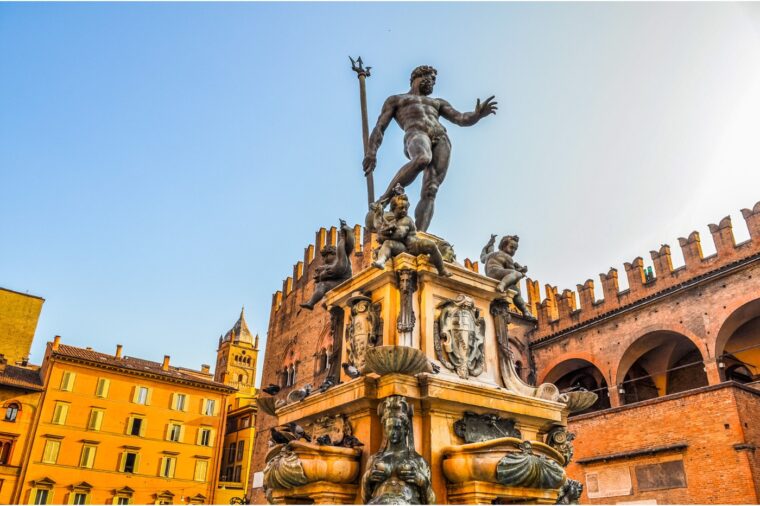
Just a short walk away stands the Fountain of Neptune, one of Bologna’s most photographed monuments. Created in the 16th century from a design by Giambologna, it remains one of the defining symbols of Renaissance Bologna and an essential stop when exploring the historic center.

Step Inside the Basilica of San Petronio

Ranked among the largest churches in Europe, the Basilica of San Petronio houses remarkable works of art, historic chapels and one of the city’s most fascinating scientific treasures: Giovanni Domenico Cassini’s meridian line, one of the longest in the world.

Its unfinished façade has become one of Bologna’s most distinctive landmarks and a symbol of the city’s complex history.

Admire the Two Towers

The Asinelli and Garisenda towers are among the most recognizable symbols of medieval Bologna. During the Middle Ages, dozens of noble families built towers throughout the city as expressions of wealth and influence. Today, the Two Towers remain the most visible reminder of that prosperous period.

Although restoration work currently prevents visitors from climbing them, they remain one of the city’s most iconic sights and a must-see for anyone visiting Bologna.

Explore the Quadrilatero

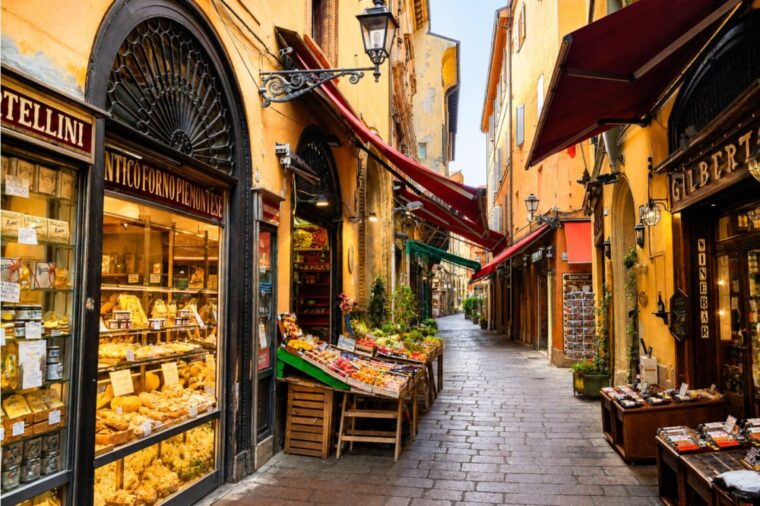
Just a few steps from Piazza Maggiore lies the Quadrilatero, Bologna’s ancient market district and one of the most fascinating areas of the historic center.

Among narrow alleys, food stalls, delicatessens and centuries-old artisan botteghe, visitors can experience the city’s enduring connection with its culinary heritage. It is one of the best places to experience everyday local life, discover authentic Bolognese specialties and understand why Bologna is considered one of Italy’s great food capitals.

If you wish to bring local products home, many shops can arrange international shipping.

Discover the Historic Shops

Bologna preserves an extraordinary heritage of artisanal and commercial traditions. Fresh pasta shops, traditional drogherie, bakeries and family-run workshops continue to play an important role in daily life.

Many of these businesses have been passed down through generations and offer visitors a glimpse into traditions that have shaped the city’s identity for centuries.

Taste Authentic Bolognese Cuisine

No visit to Bologna would be complete without exploring its cuisine. Beyond famous dishes such as tortellini and tagliatelle al ragù, visitors should also seek out local favourites including gramigna with sausage, a traditional local pasta dish, friggione (a slow-cooked onion and tomato specialty), crescentine, bollito misto and cotoletta alla bolognese.

Each dish reflects a different chapter of the region’s history and remains an important part of local culture. For food lovers, tasting traditional Bolognese cuisine is undoubtedly one of the best things to do in Bologna.

Stop at a Historic Osteria

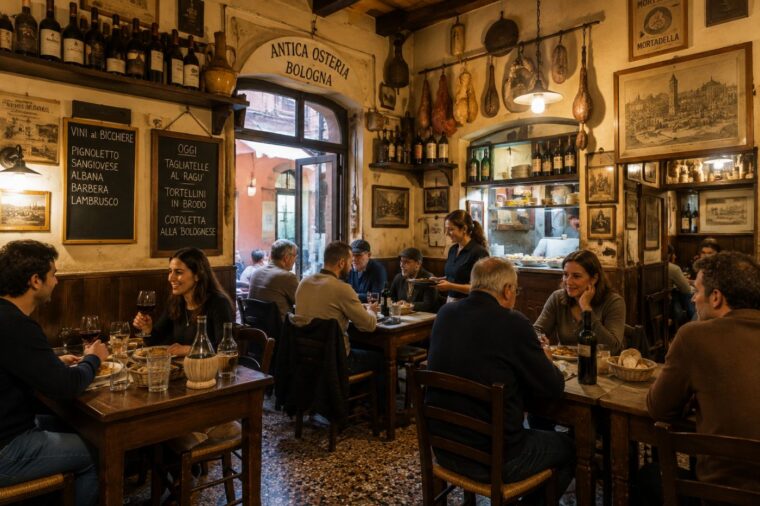
To understand Bologna’s food culture, spending time in a traditional osteria (local taverns) is essential.

For centuries these establishments have served as places of conviviality, discussion and social life, welcoming students, workers, merchants and intellectuals. Today they continue to offer an authentic glimpse into the city’s character and hospitality.

Visit the Mercato delle Erbe

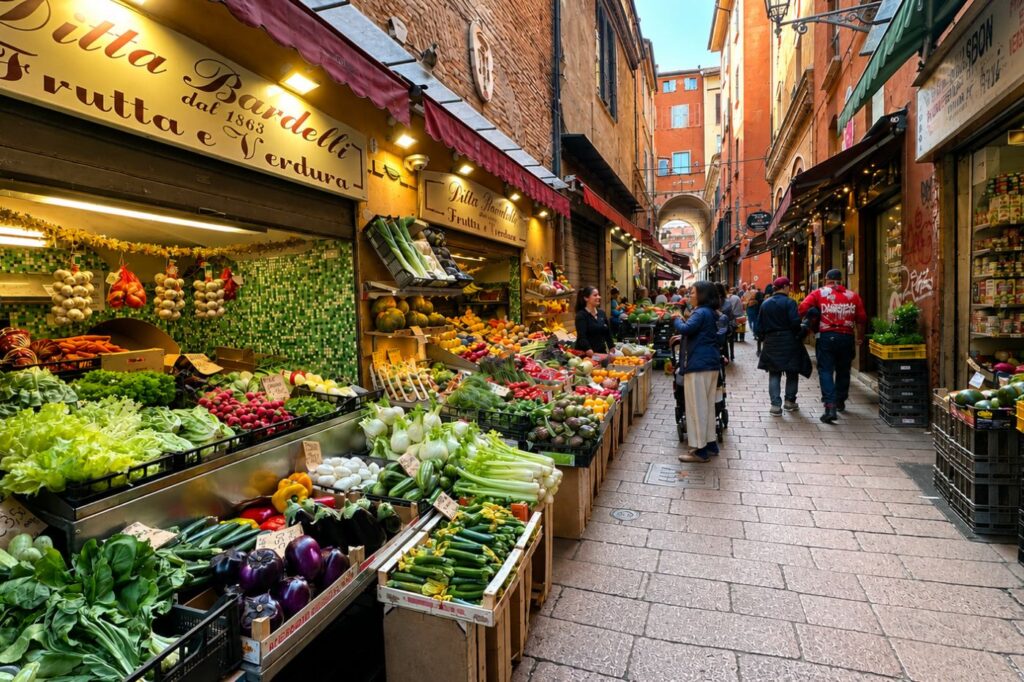
Less touristy than the Quadrilatero but beloved by locals, the Mercato delle Erbe provides a genuine insight into everyday life in Bologna.

Its stalls display fresh fruit, vegetables, fish, meat and regional specialties, showcasing the richness of Emilia-Romagna’s food heritage. The market also features numerous eateries where visitors can enjoy lunch, dinner, a quick snack or a traditional aperitivo.

For travellers seeking authentic local experiences rather than tourist attractions, Mercato delle Erbe is one of the most rewarding places to visit in Bologna.

Walk Up to the Archiginnasio

Originally the seat of the University of Bologna, the Archiginnasio is one of the city’s most fascinating historic landmarks. Its courtyards, the coats of arms left by students from across Europe, and the famous Anatomical Theatre bear witness to the central role Bologna has played in the history of higher education and Western culture.

For visitors interested in history, art and academia, the Archiginnasio remains one of the most important places to see in Bologna.

Visit the City’s Most Interesting Museums

Bologna offers a wealth of opportunities for lovers of art, archaeology and motorsports. The Civic Archaeological Museum preserves remarkable artefacts from the Etruscan and Roman periods, while MAMbo showcases modern and contemporary art through an extensive collection and temporary exhibitions.

Motorsport enthusiasts should not miss the Ducati Museum in Borgo Panigale, where visitors can discover the history of one of Italy’s most iconic motorcycle manufacturers and an important symbol of Emilia-Romagna’s industrial heritage.

Whether your interests range from ancient civilizations to contemporary art or Italian engineering, Bologna’s museums provide some of the city’s most rewarding cultural experiences.

Reach the Sanctuary of San Luca

Perched atop the Colle della Guardia, the Sanctuary of the Madonna di San Luca dominates Bologna’s skyline and is one of the city’s most beloved landmarks.

The sanctuary can be reached on foot by following the world’s longest portico, which stretches for almost four kilometres and connects the historic center to the hilltop church. The walk itself is considered one of the best things to do in Bologna, offering a unique combination of history, architecture and panoramic views.

For photography enthusiasts, San Luca provides one of the finest viewpoints in the city. On clear days, visitors can admire Bologna’s terracotta rooftops, the surrounding countryside and the first foothills of the Apennines.

If possible, plan your visit for late afternoon. As the sun begins to set, the rooftops of the historic center take on warm golden hues, creating one of the most photographed views in Bologna.

Search for the Seven Secrets of Bologna

Hidden windows, mysterious inscriptions, optical illusions and local legends: the so-called “Seven Secrets of Bologna” offer an entertaining way to explore the city from a different perspective.

For travellers looking for unusual things to do in Bologna, these curious stories reveal a lesser-known side of the city that many visitors overlook.

Visit Santo Stefano

Known also as the Complex of the Seven Churches, Santo Stefano is one of Bologna’s most atmospheric and historically significant sites.

Its cobbled square, elegant architecture and interconnected religious buildings create a unique setting that reflects centuries of religious, artistic and urban development.

Beneath the surrounding porticoes, visitors will also find traditional cafés, wine bars and restaurants, making the area an ideal stop during a day spent exploring the historic center.

Join a Cooking Class

Learning how to prepare tortellini or tagliatelle alongside local experts is one of the most authentic ways to experience Bolognese culture.

A cooking class offers far more than a recipe. It provides insight into the techniques, traditions and family stories that have shaped Emilia-Romagna’s culinary identity for generations.

For many international visitors, a pasta-making class is among the most memorable things to do in Bologna and a perfect way to bring a piece of local culture home.

If you would like to enjoy this experience, Bologna Food Experience can recommend carefully selected cooking classes and workshops.

Take a Food Tour

Among the most popular activities for international visitors is a guided food tour.

Led by local experts, these experiences take participants through historic markets, artisan food shops, traditional osterie and some of the city’s most iconic streets. Along the way, visitors learn not only what to eat, but also how local products and recipes became central elements of Bolognese identity.

A Bologna food tour combines gastronomy, history and local culture, making it one of the best ways to discover the city beyond its major attractions.

For those wishing to deepen their understanding of Bologna’s culinary heritage, a food tour often provides insights that would otherwise remain hidden from casual visitors.

Stroll Through Giardini Margherita

Located just outside the busiest areas of the historic center, Giardini Margherita is Bologna’s most popular urban park.

Opened in 1879 and inspired by English landscape gardens, it offers a peaceful setting for a leisurely walk, a picnic or a break from sightseeing.

With its small lakes, majestic trees and shaded pathways, the park attracts students, families and runners throughout the year and provides a glimpse into everyday life beyond the tourist areas.

Experience Bologna After Dark

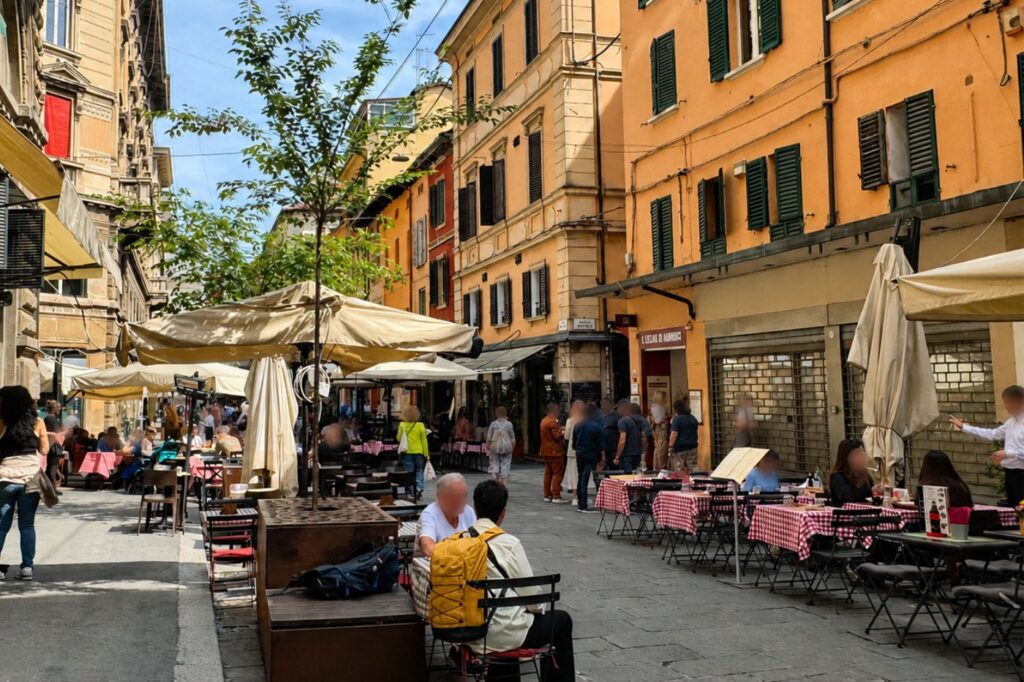
As evening falls, Bologna reveals another side of its character. The piazzas fill with residents and visitors, wine bars and osterie become lively gathering places, and the illuminated porticoes create a distinctive atmosphere found nowhere else in Italy.

For those wondering what to do in Bologna at night, simply wandering through the historic center can be an experience in itself.

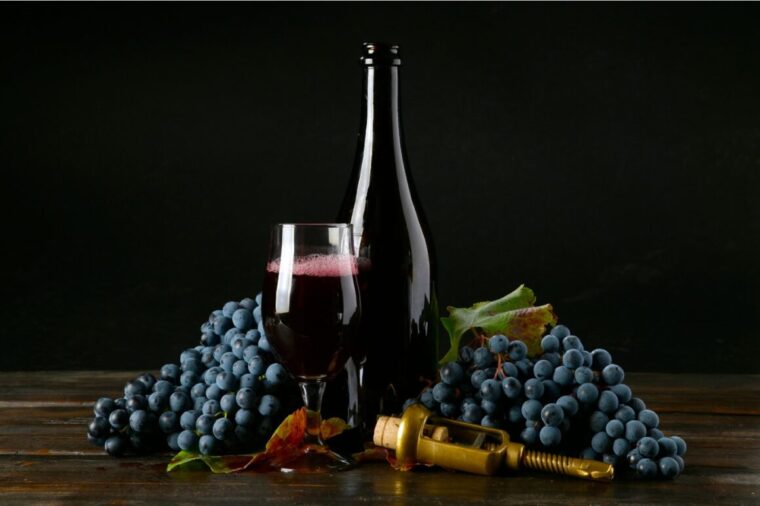
Enjoying a glass of wine from the Colli Bolognesi, sharing local specialties with friends or lingering beneath the porticoes are among the simplest and most authentic pleasures the city has to offer.

Bologna Deserves More Than a Brief Visit

Many visitors arrive in Bologna expecting to spend only a day, only to discover that the city merits a slower pace of exploration.

Few destinations manage to combine history, gastronomy, university traditions and everyday local life in such a natural and distinctive way.

For this reason, the question is not simply what to do in Bologna, but how to experience it.

And often, the answer lies in the simplest moments: walking beneath the UNESCO-listed porticoes, sharing a conversation in a traditional osteria, tasting handmade tortellini, enjoy a glass of Pignoletto or exploring a market that still preserves the atmosphere of centuries past.

Bologna is not merely a city to visit; it is a city to experience.

FAQ – Frequently Asked Questions

Is Bologna worth visiting?

Absolutely. Bologna is one of Italy’s most rewarding destinations, combining medieval architecture, UNESCO-listed porticoes, world-famous cuisine, vibrant university life and a rich cultural heritage. Unlike many Italian cities, it offers an authentic atmosphere where visitors can experience both major landmarks and everyday local life.

How many days are needed to visit Bologna?

Two to three days are ideal for exploring Bologna at a comfortable pace. This allows enough time to visit the main attractions, discover local food markets, enjoy traditional Bolognese cuisine, walk to San Luca and experience the city’s unique atmosphere beyond the most popular tourist sites.

Is 2 days enough in Bologna?

Yes. Two days are enough to see Bologna’s main highlights, including Piazza Maggiore, the Two Towers, the Quadrilatero, the Archiginnasio and the Sanctuary of San Luca. However, many visitors choose to stay longer to enjoy the city’s food culture and explore it at a more relaxed pace.

What to do in Bologna in one day?

If you only have one day in Bologna, start in Piazza Maggiore and visit the Basilica of San Petronio and the Fountain of Neptune. Continue to the Quadrilatero market district, admire the Two Towers, stroll beneath the UNESCO-listed porticoes and visit the Archiginnasio. End your day with dinner in a traditional osteria and a walk through the illuminated historic center.

What is Bologna famous for?

Bologna is famous for its food culture, medieval porticoes, historic university and well-preserved city center. It is the birthplace of iconic specialties such as tortellini, tagliatelle al ragù and mortadella, and is often considered one of Italy’s leading gastronomic destinations.

What not to miss in Bologna?

The highlights of Bologna include Piazza Maggiore, the Basilica of San Petronio, the UNESCO-listed porticoes, the Two Towers, the Quadrilatero market district, the Archiginnasio, Santo Stefano and the Sanctuary of San Luca. Food lovers should also explore the city’s historic markets and traditional osterie.

Is Bologna a walkable city?

Yes. Bologna is one of the most walkable cities in Italy. The historic center is compact, most attractions are within walking distance and the extensive network of porticoes provides shelter from both sun and rain throughout the year.

What to do in Bologna at night?

In the evening, Bologna’s historic center comes alive with locals and visitors. Traditional osterie, wine bars, restaurants and lively piazzas create a welcoming atmosphere. Walking beneath the illuminated porticoes, enjoying local food and tasting wines from the Colli Bolognesi are among the most enjoyable nighttime experiences in the city.

Is Bologna family-friendly?

Yes. Bologna is well suited to families thanks to its pedestrian-friendly historic center, extensive porticoes, parks and museums. Attractions such as Piazza Maggiore, the Sanctuary of San Luca, Giardini Margherita and many cultural sites can be enjoyed by both adults and children.
Bologna’s Osterie: History, Traditions and Fun Facts of the Real Bologna

These were places where wine was poured by the glass, politics were debated, and relationships were forged. The history of these osterie captures the true soul of Bologna, one that goes far beyond its food scene

Visitors to Bologna are often drawn by its world-renowned cuisine and local specialties. However, simply tasting tortellini, tagliatelle al ragù, or mortadella is not enough to truly grasp the city’s soul.

To fully understand Bologna’s food culture, it is worth stepping into one of the places that for centuries represented the beating heart of everyday life: the osteria.

Bolognese osterie (taverns) originated as places to drink and socialize, frequented by merchants, students, artisans, and travelers. For a long time, wine took precedence over food, and community life revolved around shared tables, conversation, and strict rules imposed by city authorities. Only in more recent times did these venues take on the culinary role that we associate with Emilian tradition today.

What Are Bolognese Osterie?

Before evolving into restaurants dedicated to local cuisine, osterie were public establishments that sold wine and offered basic hospitality to residents and travellers passing through the city.

In the Middle Ages, they represented one of the most important spaces in urban life. This was a gathering place for university students, workers, merchants, and pilgrims. Here, business deals were closed, news was exchanged, and social bonds were formed.

In many ways, the osteria functioned as a cross between a wine tavern, a meeting place and a neighbourhood gathering spot.

The Medieval Origins of Osterie

The presence of inns and osterie in Bologna dates back to the Middle Ages. As home to the oldest continuously operating university in the Western world, the city attracted students and professors from all over Europe. They were joined by merchants, pilgrims, and laborers travelling along Northern Italy’s main trade routes.

These establishments met practical needs: providing wine, shelter, and, in some cases, simple food. Bread, cheeses, cured meats, and seasonal dishes made up most of what was on the menu.

Their location near city gates, markets, and high-traffic areas was no coincidence. In fact, osterie were an integral part of the urban economy, shaping the daily life of anyone arriving in or moving around the city.

How the Municipality Regulated Osterie

Over the centuries, the number of osterie grew considerably, prompting city authorities to regulate their business.

As early as the Communal Era (12th century), laws were in place governing prices, measurements, wine sales, operating hours, and public order. The municipality’s goal was to curb fraud, abuses, and behavior deemed problematic. This level of oversight proves just how important osterie had become, not only economically but socially as well.

Wine: The Heart of the Osteria

To truly understand the Bolognese osterie, one must start with the wine.

For centuries, daily wine consumption was far more widespread than it is today. Wine was a safe alternative to water, which was not always potable, and was considered an integral part of the daily diet.

In the osterie, people bought bulk wine, which often came from the Colli Bolognesi hills and the surrounding countryside. Wine lists and tastings as we know them today did not exist; the innkeeper personally knew the producers and suppliers, serving whatever came from the local area.

Many venues hung branches or leafy boughs (frasche) outside their doors to signal that wine was available. This very custom gave rise to the popular Italian expression “vendere vino alla frasca” (literally, “selling wine under the branch”), a phrase used in many parts of Italy.

A Place to Meet, Talk and Debate

Above all, osterie were places for socializing.

People from all walks of life crossed paths there, from university students and artisans to porters, merchants, professionals, and travellers. Together, they sat side by side to debate work, politics, local gossip, and business, while also playing cards and spending hours in each other’s company.

In an era before widespread newspapers, radio, or television, the osteria was also a primary space for spreading news. In many respects, it functioned as an indoor public square.

Sharing tables with strangers was a common practice, encouraged by the very layout of the venues and the highly collective nature of urban life.

Games, Morra, and Prohibitions

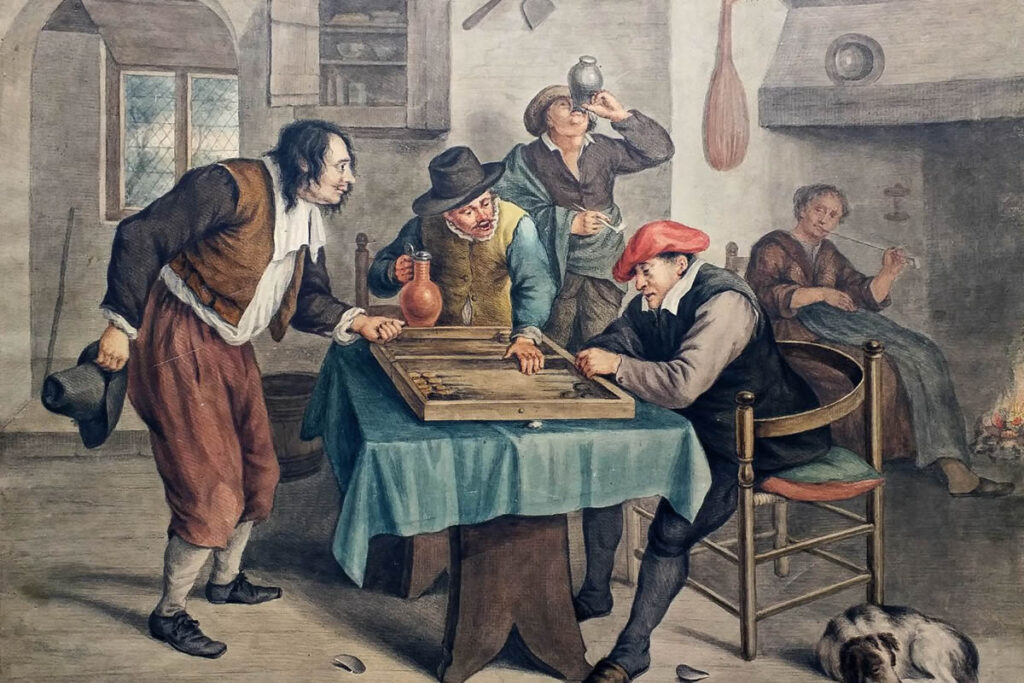
Card games and morra — an ancient game based on quick math and intuition — were among the most popular pastimes. However, authorities looked upon these activities with suspicion, especially when betting was involved. As a result, strict prohibitions and inspections were frequently introduced to curb behavior seen as a source of public disorder.

Among the pastimes in the osterie were card games and morra.

From Wine Glasses to Traditional Dishes

For centuries, food was not the main attraction in the osterie. Many customers would buy bread, cheeses, cured meats, and other items from nearby shops and eat them alongside the wine served by the innkeeper. This practice was especially popular among students and workers.

It was only between the 19th and 20th centuries that osterie began transforming into places to enjoy regular meals. This era saw the debut of the dishes that define Bolognese cuisine today: tagliatelle al ragù, tortellini in brodo, gramigna with sausage, boiled meats (bollito misto), and cotoletta alla bolognese.

The evolution of the osteria mirrors the changing city and the shifting culinary habits of its people.

The Connection to the Quadrilatero

Many of Bologna’s most historic osterie sprouted within the Quadrilatero, the city’s medieval market district.

This neighbourhood was one of the city’s busiest commercial districts, home to food shops, delicatessens, fishmongers, butchers and merchants.

The osteria naturally became the meeting point for those buying fresh produce and anyone wanting to stop for a drink and a chat.

Even today, the Quadrilatero preserves this heritage, standing as one of the best places to understand the deep-rooted relationship between trade, gastronomy, and conviviality in the city’s history.

Osteria del Sole: A Living Tradition

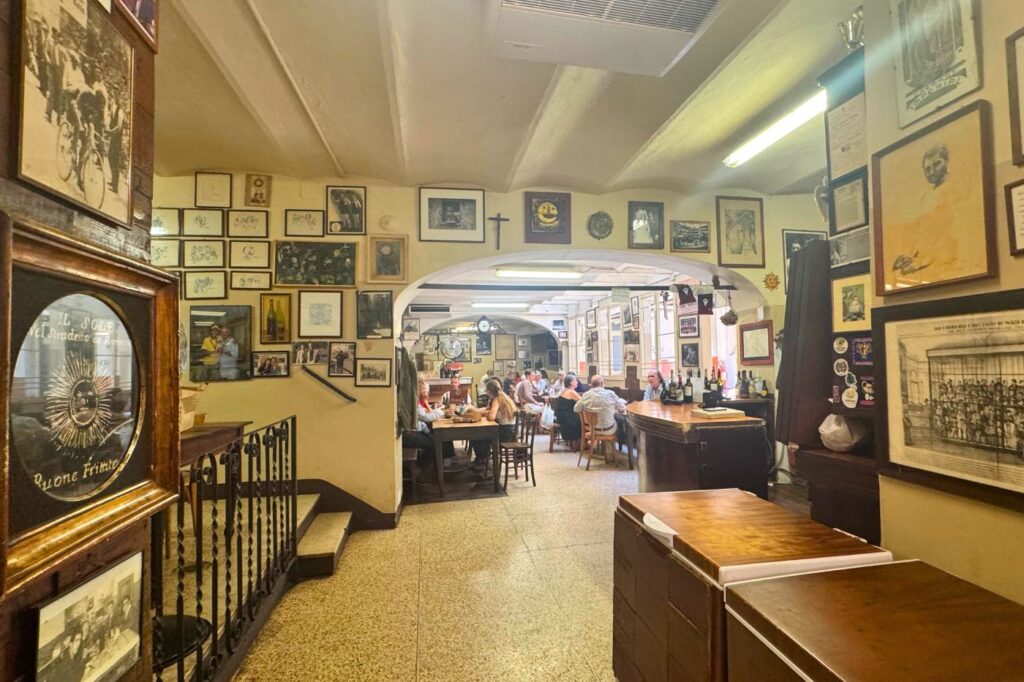
One of the most famous symbols of Bolognese tradition is the Osteria del Sole, in Vicolo Ranocchi 1/d. Founded in 1465, it is considered one of the oldest continuously operating osterie in Italy.

Its unique charm lies in having preserved a practice that directly echoes the past: here, you buy the wine, but you can bring your own food from the outside. Just as it was centuries ago, this is a tangible testament to the continuity between medieval and contemporary Bologna.

Osteria del Sole, Vicolo Ranocchi, 1/d (Foto © BFEX).

Why Osterie Still Embody the Real Bologna

Inevitably, many osterie have changed their purpose. Some have turned into restaurants, while others have adapted to the demands of modern tourism. Yet, they continue to safeguard a vital piece of the city’s identity.

Stepping into a historic osteria allows you to see Bologna from a different perspective that monuments and museums alone cannot provide. It reveals how wine, food and conviviality helped shape relationships, communities and traditions across generations.

For anyone wishing to truly know Bolognese food culture, osterie are far more than just places to eat or drink.

Don’t just rush in and out between sightseeing stops. Pause, take your time for a glass of wine and some traditional specialties, and just look around you.

Those walls and time-worn tables have seen generations of Bolognese people pass through. They have witnessed nights spent in good company, heated debates, friendships born over a glass of wine, and even love stories blossoming over a plate of tagliatelle.

In some of these very osterie, artists, musicians, and songwriters found the inspiration that would go on to shape Italian culture. Stepping inside means becoming part of a centuries-old story, if only for a few hours.

The Bologna Quadrilatero: The History of the City’s Oldest Market

From medieval guilds to today’s historic shops: a journey through Bologna’s gastronomic and commercial heart, amidst narrow alleys, porticoes, and centuries-old traditions

In the historic center of Bologna, there is a place where commerce has continued almost uninterrupted since the Middle Ages. This is the Quadrilatero, a network of streets stretching behind Piazza Maggiore which, to this day, represents one of the most recognizable symbols of the city.

Amid historic delicatessens, fresh pasta workshops, fishmongers, ancient osterie (taverns), and botteghe (specialty food shops), the Quadrilatero preserves an identity shaped by centuries of urban history, commercial trade, and gastronomic culture.

Today it is one of the most visited areas by both Italian and foreign tourists, yet it remains above all a living neighborhood, still tied to the daily habits of the locals. Within its narrow alleys, one encounters remnants of the Middle Ages, artisanal traditions, new commercial venues, and a food culture that continues to intertwine with the market’s original function.

A stroll through these streets offers a meaningful insight into Bologna’s economic history and its gastronomic reputation. For this reason, telling the story of the Quadrilatero means starting from the relationship between the city, its commerce, and its food.

Shops of the ancient market district of the Quadrilatero (Foto © BFEX). 

The Quadrilatero: Bologna’s Oldest Market

The Quadrilatero is Bologna’s oldest market and occupies an area of the historic center roughly bordered by Via Rizzoli, Via Castiglione, Via Farini, and Via dell’Archiginnasio. Within this perimeter unfolds a maze of narrow streets that are among the most famous and popular in the city, such as Via Pescherie Vecchie, Via Drapperie, Via Clavature, and Vicolo Ranocchi.

The name “Quadrilatero” is relatively recent, but the commercial function of this area dates back at least to the 11th century. In fact, during the Middle Ages, the most important mercantile and artisanal activities of communal Bologna were concentrated here.

The location was strategic because the market stood adjacent to the political and religious heart of the city, near Piazza Maggiore and the Basilica of San Petronio. Between the 12th and 13th centuries, Bologna was one of Europe’s leading economic and cultural hubs — thanks in part to the presence of the Western world’s oldest university — and where the food trade took on a central role in urban life.

The Medieval Origins of the Bolognese Market

Historical sources testify that as early as the Middle Ages, this area was organized according to a precise division of commercial activities. Bologna was then a wealthy, populous city, traversed by intense economic traffic. The guilds (Corporazioni delle Arti) strictly regulated the trades, establishing rules, prices, and quality standards of goods.

The Quadrilatero was born precisely as a specialized marketplace where each street was dedicated to a specific professional category. Many current street names still derive from those medieval trades.

Via Drapperie was home to drapers and textile merchants; Via Clavature housed blacksmiths and ironworkers (chiavaturieri); Via Pescherie Vecchie was reserved for the fish trade. Shops opened directly onto the porticoes, with goods displayed outside and a constant flow of customers, merchants, and townspeople.

This layout of the Quadrilatero perfectly reflects the economic organization of Italian communal cities. The guilds, in addition to being professional associations, represented true centers of economic and social power. In this maze of alleys, therefore, one of the earliest examples of a stable and specialized urban market in medieval Italy developed.

Guilds, Arts, and the Food Trade

In medieval Bologna, the guilds held enormous importance in the city’s governance. Each professional category was organized into guilds that controlled access to the trade, product quality, and sales methods.

The Quadrilatero was primarily home to food merchants, apothecaries, butchers, fishmongers, bakers, and cured meat vendors. Over the centuries, Bologna became famous for its pork processing, earning itself the nickname “Bologna la Grassa” (Bologna the Fat).

Mortadella, already well-known in the Renaissance era, was one of the market’s signature products. Alongside cured meats, local cheeses, wines from the Colli Bolognesi, bread, and fresh pasta were sold.

The fish trade also held considerable importance, despite Bologna not being a maritime city. In fact, the commercial links with the Adriatic Sea allowed for the regular arrival of fresh fish destined for the city market.

The Quadrilatero was not just a retail space, but a complex economic system capable of supporting production, distribution, craftsmanship, and daily consumption.

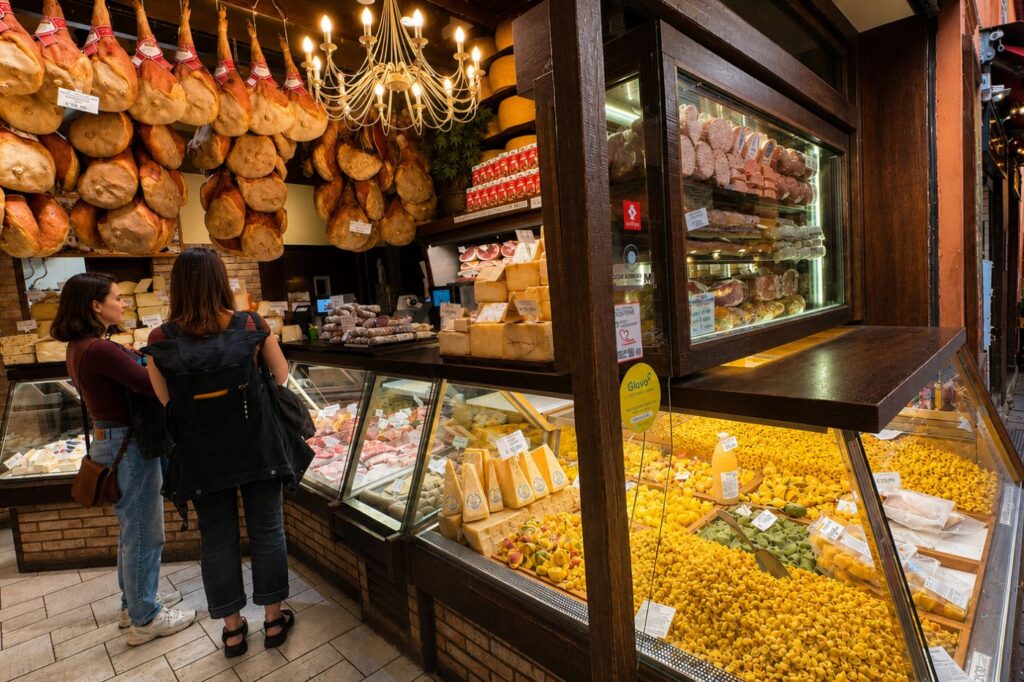
A delicatessen shop in the Quadrilatero district (Photo © BFEX).

The Quadrilatero and the Relationship with the Porticoes of Bologna

One of the most characteristic features of the historic food quarter is its connection to the porticoes, a symbol of Bolognese architecture and now a UNESCO World Heritage site.

The medieval porticoes were born partly out of commercial needs. In fact, they made it possible for shopkeepers to extend their workspaces toward the street, while simultaneously protecting goods and customers from the rain and sun. In the Quadrilatero, this function is still evident today. Walking through its streets, one senses a continuity between public space and commerce that stems directly from medieval urban planning.

The homes of merchants and artisans were developed above the shops, creating a fusion of private life and working activity typical of medieval Italian cities.

Even today many buildings retain ancient traces: arches, historic signage, low porticoes, and narrow alleys that evoke the market’s original atmosphere.

From the Renaissance to the Modern Era

During the Papal rule, Bologna maintained an important commercial role, and the district continued to serve as the economic heart of the city.

Between the 16th and 18th centuries, chronicles described the market as an extremely vibrant space, rich in scents, sounds, and colors. Goods were displayed directly on the street, while vendors and customers continuously crowded the shops.

Many merchant families passed their businesses down through generations, contributing to the historical continuity of the quarter.

During this period, the Quadrilatero also consolidated its gastronomic reputation. Bologna became one of the Italian capitals of fine food, and the market’s shops gained fame far beyond the city walls. The area’s osterie were frequented by university students, travelers, aristocrats, and common people alike.

The Transformations Between the 19th and 20th Centuries

The 19th century brought significant urban changes to Bologna, but the Quadrilatero managed to preserve much of its medieval structure. While other areas were modernized, the market maintained its historical identity due to the complexity of its urban fabric, made of narrow streets and clustered buildings.

In the 20th century, however, the Quadrilatero went through a delicate phase. The rise of large-scale retail and changing consumer habits posed a threat for many traditional shops. As happened in numerous historic European markets, there were fears here too of a gradual loss of the area’s original identity.

Nevertheless, Bologna succeeded in preserving its historic market thanks to the strong bond between the city and its local gastronomic culture. The specialty food shops continued to represent a point of reference for the locals, keeping artisanal skills and commercial traditions alive.

Via degli Orefici, in the Quadrilatero district, is full of restaurants (Photo © BFEX).

Why the Quadrilatero Is One of the Best Places to Visit in Bologna

In recent decades, the Quadrilatero has become one of the emblematic destinations of food and wine tourism in Bologna. Every year, thousands of visitors walk through these streets to discover the authentic flavors of Emilian cuisine.

Despite the growth of tourism and the transformation of the historic center, the Quadrilatero continues to serve a practical function in everyday city life. In the morning, the shops are frequented by residents, restaurateurs, and local workers, while in the evening, the alleys fill with Italian and foreign visitors drawn by Bolognese cuisine and the atmosphere of the historic market.

In recent years, the area has experienced noticeable changes, with the opening of new venues and increasing tourist pressure that has partly altered the district’s commercial balance. Yet, the Quadrilatero still preserves the character of an authentic urban space, where the food commerce is not merely a tourist attraction but an everyday practice that continues to define the identity of Bologna’s historic center.

Lambrusco: The Wine of Joy and Conviviality, Symbol of Emilia

From rural family tables to contemporary restaurants, its lively bubbles and straightforward character make it the wine that best embodies the gastronomic soul of Emilia. Here is its history, characteristics, and best food pairings

For many years, Lambrusco was considered merely a simple, popular, everyday wine. Over time, however, it has earned increasing respect thanks to the work of producers who prioritized quality, successfully bringing its territorial identity, historic grape varieties, and gastronomic potential to the fore.

Sparkling, fresh, and immediate, yet far from ordinary, Lambrusco is one of the Italian wines most deeply tied to the local cuisine. In Emilia, it has always accompanied cured meats, stuffed pasta, boiled meats, and rich traditional dishes, becoming an integral part of the region’s convivial culture.

Behind its vibrant color and apparent simplicity lies an ancient history spanning centuries of agriculture, trade, and rural life.

The Origins of Lambrusco

The roots of Lambrusco are incredibly old. Some scholars trace the presence of wild “lambrusche” vines in the Po Valley back to the Etruscan, and Roman eras. The name is believed to derive from the Latin labrusca, a term used to indicate wild vines that grew spontaneously at the edges of fields.

Over the centuries, Lambrusco evolved into one of the most representative wines of Emilia, particularly within the provinces of Modena, Reggio Emilia, and Parma.

For generations, it served as the staple wine for rural farming families: easy-drinking, naturally vibrant, and perfectly suited for the region’s hearty cuisine. Its natural re-fermentation made it stable and ideal for daily consumption.

Between the 1960s and 1980s, Lambrusco experienced a massive international boom, especially in the United States, becoming one of the most exported Italian wines globally. However, that industrial-scale production contributed to an oversimplified perception of the wine, which became widely associated with overly sweet versions that lacked territorial identity.

In recent decades, numerous producers have initiated a major quality revival, refocusing their efforts on preserving indigenous grapes, implementing precise vinification techniques, and honoring the wine’s territorial identity.

The Main Varieties and the Different Types of Lambrusco

Speaking of Lambrusco in the singular is reductive. The name actually identifies a large family of indigenous Emilian grape varieties grown primarily between Modena, Reggio Emilia, and Parma. Each variety possesses distinct characteristics and yields wines with vastly different personalities.

Among the best known is Lambrusco di Sorbara, grown in the Modenese plains between the Secchia and Panaro rivers. It is one of the most elegant and recognizable expressions: lighter in color, featuring floral aromas, notes of small red berries, and a sharp acidity that makes it particularly food-friendly. It traditionally accompanies mortadella, cured meats, and Emilian fried specialties.

Conversely, Lambrusco Grasparossa di Castelvetro, cultivated in the hilly areas of the Modena province, offers darker, more structured, and tannic wines, with intense aromas of blackberry and ripe cherry. It is arguably the most full-bodied Lambrusco and pairs well with grilled meats, bollito misto (boiled meats), and rich Emilian dishes.

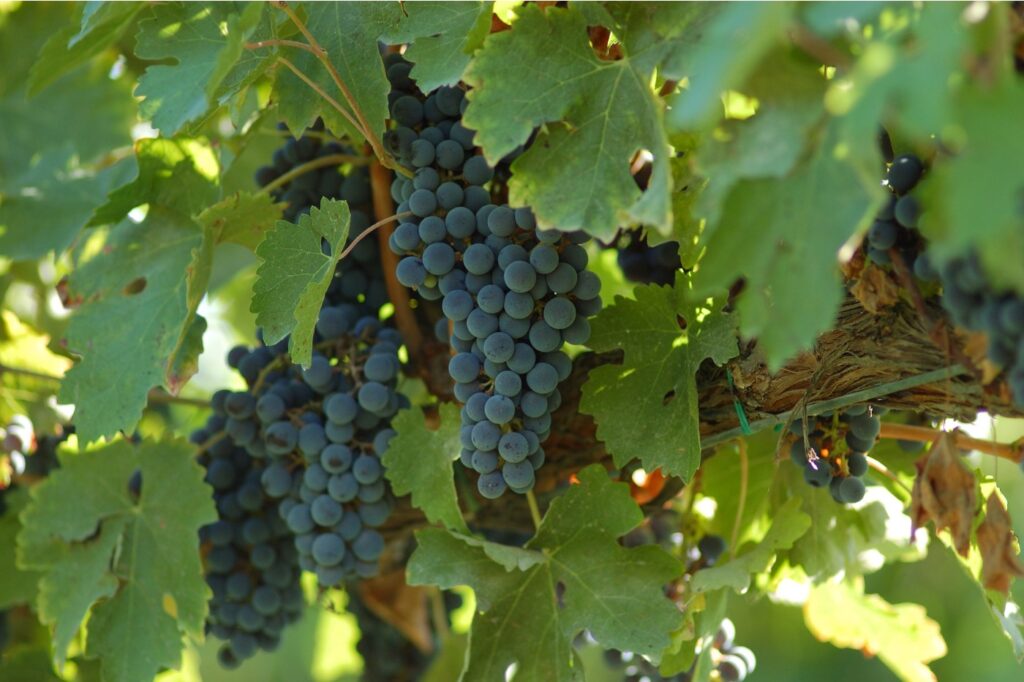
Also widely appreciated is Lambrusco Salamino di Santa Croce, named after the cylindrical shape of its grape clusters resembling salami. It produces balanced, soft and versatile wines, often characterized by freshness and easy drinkability.

Alongside these main varieties, there are other historical grapes like Lambrusco Maestri, Marani, Montericco, and Viadanese, used in specific appellations or blends to impart structure, color, or aromatic complexity.

Today, Lambrusco is produced in various styles: frizzante (lightly sparkling), spumante (fully sparkling), bottle-refermented, rosé, and even Metodo Classico (traditional method). This range of interpretations demonstrates how a wine often deemed simple can, in fact, express remarkable territorial and stylistic complexity.

Characteristics of Lambrusco

Lambrusco is generally a frizzante or spumante wine, fresh and with a lively acidity. It is characterized by aromas of red berries, violet, and cherry, with moderate tannins and a food-friendly nature. It is produced in secco (dry), abboccato (off-dry), or amabile (semi-sweet) versions, both in red and rosé expressions.

One of its most interesting qualities is its ability to cleanse the palate thanks to its acidity and effervescence, which is why it pairs perfectly with traditional Emilian cuisine, often rich in fats and savory flavors.

Lambrusco and Emilian Cuisine: The Best Pairings

Few Italian wines share such a natural bond with their regional gastronomy as Lambrusco. Classic pairings include the iconic dishes of Emilian cuisine, ranging from mortadella and cured meats to tortellini, lasagna, and tagliatelle with ragù. It is also an excellent match for bolliti misti (assorted boiled meats), zampone, cotechino, and Parmigiano Reggiano.

The fresher, high-toned Lambrusco di Sorbara pairs magnificently with mortadella, fried specialties, and soft cheeses. Whereas the more full-bodied Grasparossa ideally accompanies grilled meats, game, and rich, intense dishes.

The rosé or lighter expressions may be pleasantly surprising when paired with Asian cuisine, street food, and contemporary aperitifs.

Lambrusco Today

In recent years, Lambrusco has undergone a genuine critical reappraisal. Many high-end restaurants have begun incorporating it back on their wine lists, while a new generation of winemakers is experimenting with increasingly meticulous production methods.

International audiences are looking with growing interest at identity-driven, terroir-focused and food-friendly wines – and lambrusco possesses all of these attributes. Its strength probably lies in never having lost its link with conviviality. It remains a wine that invites people to a shared table, to the osterie, to charcuterie platters, and to Sunday family lunches.

Far more than a simple sparkling wine, Lambrusco continues to represent an authentic piece of Emilian culture.

The Bolognese Salsamentari Platter: The History and Products of a Gastronomic Symbol

Mortadella, salame rosa, crescentine, friggione and much more: a journey through the platter that preserves the gastronomic soul of Bologna and instantly creates a festive atmosphere

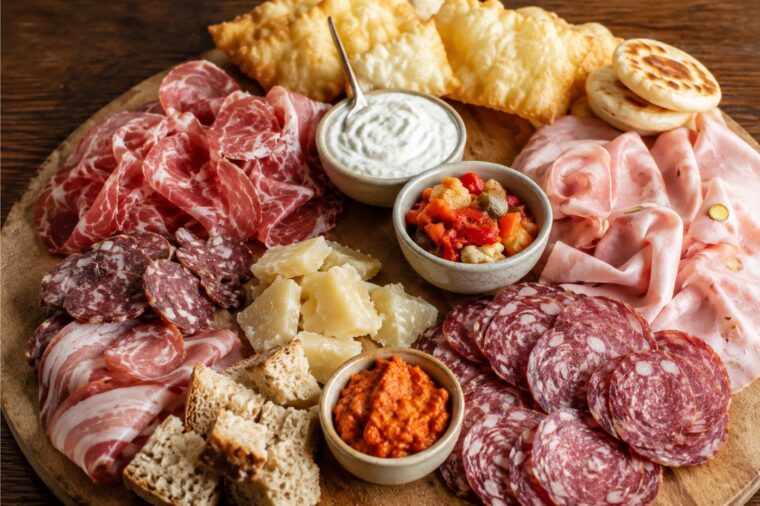
When we think of the Bolognese table, one of the most common images is certainly a large board of cured meats and cheeses accompanied by tigelle and crescentine. This is no mere appetizer; in Bologna, the tagliere is a narrative of the region and its history: a rural memory built on craftsmanship, shared labor and conviviality.

The so-called “Tagliere dei Salsamentari” (the official name of this charcuterie board) is so deeply tied to Bologna’s gastronomic identity that it has received the De.Co. (Municipal Designation of Origin) seal of approval, recognized by the Municipality of Bologna.

Behind this name lies a set of precise production standards promoted by the Mutua Salsamentari, a historic city institution tied to the local “norcina” culture (the art of pork butchery and conservation) and gastronomy. The goal is to promote products authentically rooted in the Bolognese metropolitan area and, more broadly, to the culinary heritage of Emilia-Romagna.

This is not merely a random assortment of cold cuts and cheeses, but a coherent ensemble of flavors that narrates centuries of local food history.

Who were the Salsamentari

To understand the meaning of this platter, one must look back in time to when Bologna was one of the most important cities for the trade of salt and preserved meats. The “salsamentari” were the artisans specialized in the processing, the preservation and sale of cured meats and salt-cured products.

Salt, already a precious commodity in medieval times, was essential for food preservation before the advent of refrigeration. Thanks to its strategic trading position and the “Salt Port” connected to the city’s waterways, Bologna became a major center for these crafts.

This gave rise to a gastronomic culture built around cured meats, preserves, slow-cooked preparations, and long-lasting products, many of which still appear on the traditional platters served in the city’s osterie today.

What is the “Tagliere dei Salsamentari De.Co.” 

The De.Co. recognition obtained in 2023 transformed the Tagliere dei Salsamentari into a true identity symbol of Bolognese cuisine.

The official production guidelines (disciplinare) establish that at least 70% of the products on the platter must originate from the Bologna metropolitan area or have a historically documented connection to it. The remaining portion may include other outstanding products from the from Emilia-Romagna region, provided they remain consistent with local gastronomic tradition.

The indispensable and non-negotiable centerpiece is Mortadella Bologna PGI (IGP), the undisputed “queen” of the Bolognese platter. Around it revolve historic cured meats, cheeses, traditional preparations and baked goods that may vary according to the season.

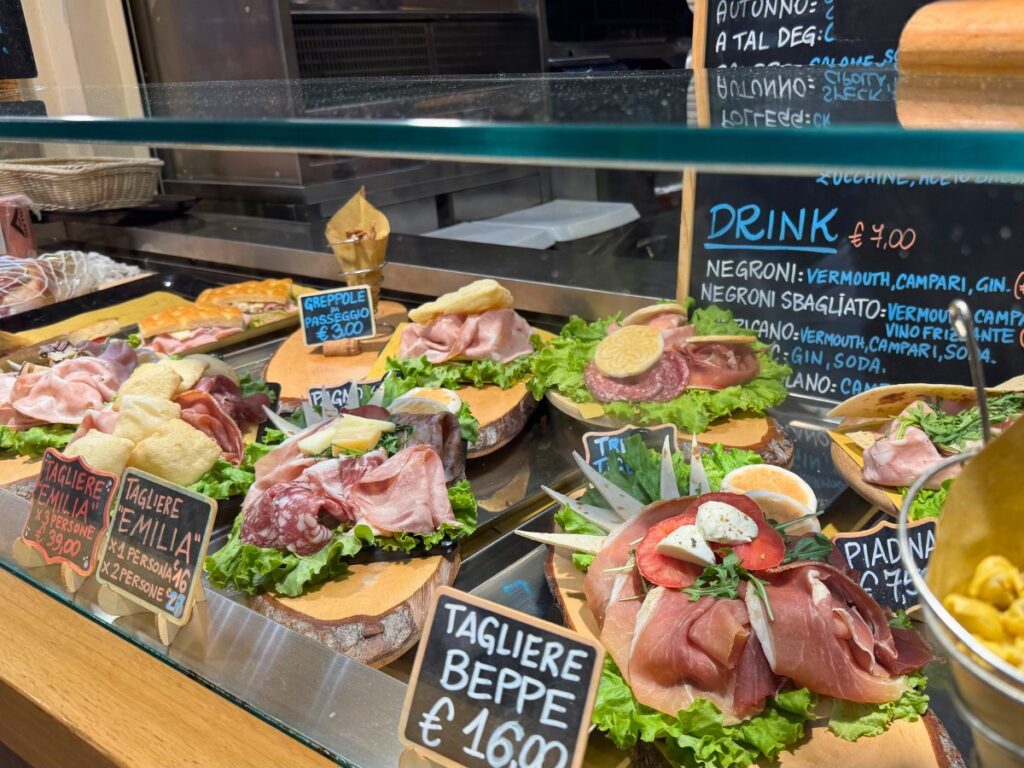
Display Case with Ready-Made Bolognese Platters (Foto © BFEX).

The Signature Products of the Bolognese Platter

The composition may vary from one venue to another, but certain products are however considered true classics of the tradition.

Among the cured meats are historic specialties such as salame rosa, coppa di testa (brawn), pancetta arrotolata (rolled pancetta), ciccioli campagnoli (fried pork cracklings), salame gentile, passita nostrana, porchetta, bondiola and cotechino. These are preparations that use every part of the pig “from the nose to the tail”, and reflect Emilia’s rural heritage. 

Alongside the cured meats are iconic local cheeses such as Parmigiano Reggiano PDO, squacquerone, pecorino from the Bolognese hills, mixed caciotte, and goat cheeses from the Apennines.

The platter is further enriched by traditional gastronomic preparations such as: friggione (onion and tomato dip), pickled vegetables (giardiniera), mortadella mousse, salsa verde and the classic spread pesto for the tigelle. 

Everything is accompanied by traditional Bolognese and Emilian baked specialties such as crescente, crescentine and tigelle.

A Platter That Changes with the Seasons 

One of the most interesting aspects of the Tagliere dei Salsamentari is its strong connection to seasonality, an element often overlooked when discussing cured meats and preserves.

During spring and summer, products such as salame gentile, porchetta, and friggione prepared with ripe tomatoes and summer onions become more prominent. Even the giardiniere follow the rhythms of the vegetable gardens of the Emilian plains.

With the arrival of autumn and winter, traditional cold-season specialties begin to appear: coppa di testa, ciccioli, cotechino, and bondiola, rich and hearty products rooted in the traditional home-based processing of pork.

This connection to the agricultural calendar ensures the platter remains a living tradition rather than a standardized formula.

Where to Taste the Tagliere dei Salsamentari in Bologna

Today, several local spots in Bologna display the official Mutua Salsamentari seal, which guarantees adherence to strict production standards and the quality of the ingredients used.

These locations are primarily historic taverns (osterie), gourmet food shops (botteghe) and wine bars (enoteche) that focus on promoting local products and rediscovering the city’s traditions.

For those visiting to Bologna, the Tagliere dei Salsamentari offers one of the most authentic ways to experience local cuisine beyond the usual tortellini or ragù. It is a gastronomic journey that introduces diners to ingredients, artisanal techniques and preparations often unfamiliar to the wider international public.

Behind every slice of mortadella, every crescentina, or spoonful of friggione lie ancient crafts, family rituals, and knowledge passed down through generations. The De.Co. certification serves not only to list specific products but to preserve the city’s culinary identity and protect consumers.


Tigelle and Crescentine: The Differences and the Tradition

Two names, one shared history, and a uniquely Emilian misunderstanding that tells a story far greater than a simple recipe

There is a moment, sitting at the table in a trattoria somewhere between Bologna and Modena, when a basket of small, warm breads arrives. Some people call them tigelle, others call them crescentine. For many, they are the same thing. In reality, they are not and understanding the difference is a way of truly entering the gastronomic culture of Emilia.

The Tigella and the Crescentina in Modena

The starting point is simple: the word “tigella” was not originally used to describe the food itself, but rather the tool used to cook it. In the tradition of the Modenese Apennines, tigelle were small terracotta discs heated in the fireplace and used to cook the dough. The bread itself, therefore, was not the tigella, it was the “crescentina”, meaning the result of the cooking.

This is a linguistic detail, but not a minor one. As often happens in popular culinary traditions, the name of the object gradually came to stand for the food itself. Today, saying “tigelle” is perfectly normal, even in restaurants, but it is a relatively recent simplification.

The “true” crescentina from the Modena area was born as a mountain bread. Made with essential ingredients and a simple preparation, they were cooked directly over the fire. There were no ovens and no elaborate equipment: the terracotta tigelle allowed small discs of dough to be cooked quickly, leaving them soft on the inside and lightly crisp on the outside.

Over time, this bread has become one of the most recognizable symbols of Emilian conviviality.

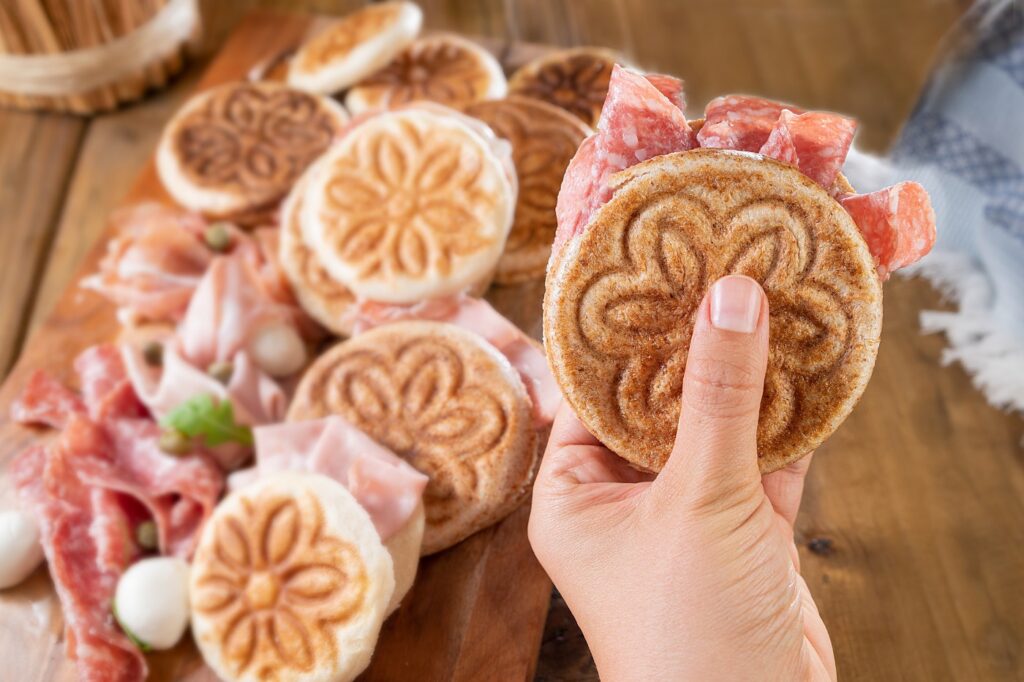
Tigelle.

Tigelle and Crescentine in Bologna

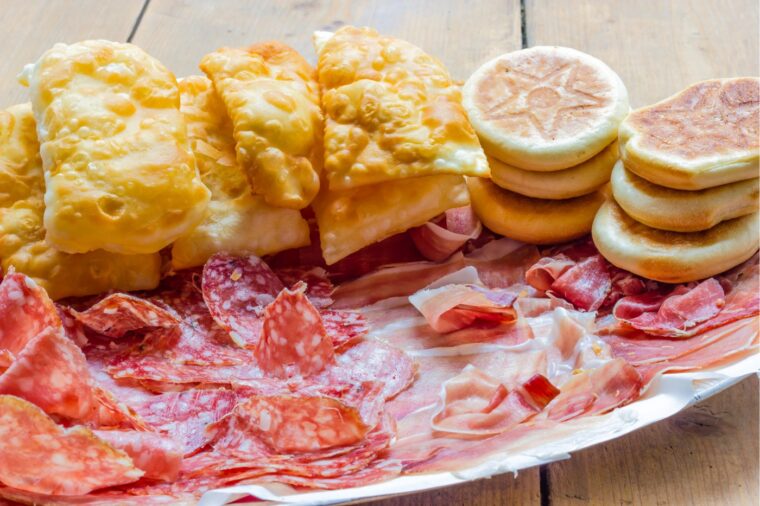
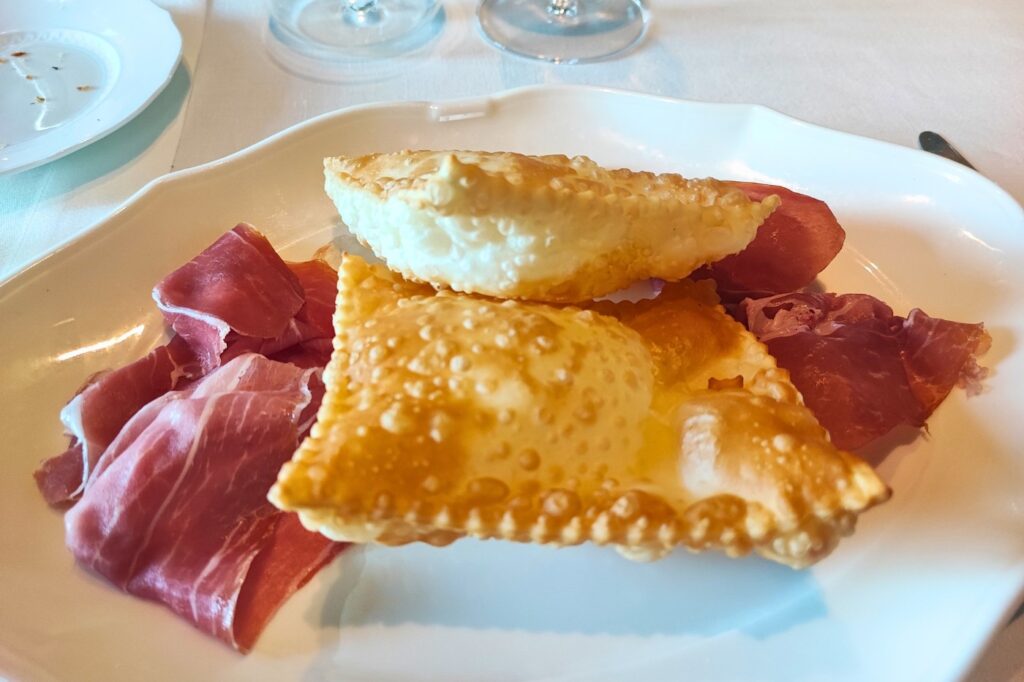
Then, as is often the case, geography complicates matters. Moving toward Bologna, the term “crescentina” changes in meaning. Here, it refers to a fried preparation: puffed, golden and closer to what in the Modenese area is called “gnocco fritto”.

Same name, completely different result.

This is one of those cases where cuisine explains better than any map how territories actually function: continuous, nuanced, never rigid.

In the meantime, the crescentine cooked in tigelle made their way down from the mountains to the city, establishing themselves firmly in the restaurant scene. Today you find them everywhere, often served in generous baskets alongside cured meats, cheeses, and spreads.

But the way of eating them has remained exactly as it always was. They are not plated individually or assembled in the kitchen. They are opened by hand, filled directly at the table, and shared. It is a simple gesture.

The crescentina bolognese, which in Modena is called gnocco fritto (Photo © BFE).

The fillings are those of the most direct Emilian tradition: mortadella, prosciutto, salami, fresh or aged cheeses. And then there is “pesto modenese”, a cream of lard, garlic, and rosemary, rooted in a rural cuisine that is surprisingly intense and deeply satisfying.

For visitors from outside the region, tigelle and crescentine are often among the very first local food experiences. They work because they are immediate, require no explaining, involve no complicated rituals, and allow you to taste several things at once.

And yet, behind this apparent simplicity lies a precise history: one made of tools that lent their names to food, of words that shift meaning across a few kilometers, of territories that overlap and blur into one another.

Calling them simply “bread” is not enough. Tigelle and crescentine are a perfect example of how Emilian cuisine manages to transform everyday necessity into cultural identity.

Ragù alla Bolognese: The Real Recipe and Its Origins

From its French roots to Italian cookbooks, all the way to its official codification: Ragù alla Bolognese is far more than a pasta sauce

«When you hear people speak of Bolognese cuisine, make a bow, for it deserves it».

With these words, in 1891, Pellegrino Artusi described Bologna and its gastronomy. A cuisine “a bit heavy” he wrote, but capable of nourishing well and long.

It is difficult to find a more fitting description of ragù alla bolognese, a condiment cherished for centuries and woven into the very fabric of memory and culture. For many foreigners it is simply “Bolognese sauce” but for the people of Bologna it is something deserving the utmost respect, a dish with a precise balance, built over time and defended with a certain stubbornness.

Before Ragù: When It Was “Ragoût”

The term “ragù” did not originate in Bologna, nor even in Italy. It derives from the French ragoût, a word appearing as early as the 17th century to describe a stewed preparation capable of “awakening the taste” (réveiller le goût).

Originally it had nothing to do with pasta. It was a cooking technique: meats, vegetables, or other ingredients left to simmer slowly, often with broth or wine.

The term reached Italy in the 18th century, as evidenced by the La Cuciniera Piemontese published in 1771, where ragù is described as a savory sauce used to whet the appetite. Even Vincenzo Corrado, in his book Il Cuoco Galante (1773), uses the term several times, always referring to stew-like preparations. It wasn’t yet the ragù we know today, but this is where it all began.

The Arrival of the Tomato and the Encounter with Pasta

Between the late 18th and 19th centuries, a change took place. The first combinations of ragù and tomato, initially in a very diluted form, began to appear in Italian cookbooks.

This was a fundamental turning point: ragù evolved from a standalone dish into a condiment. At the same time, its pairing with pasta became increasingly established, particularly in Naples, where “maccheroni alla napoletana” became one of the earliest expressions of this union between sauce and pasta. Bologna followed later, but in its own unique way.

Ragù in Bolognese Cookbooks

Leafing through 19th-century Bolognese recipe books, the term “ragù” does not yet appear clearly defined. It was Artusi himself, in his celebrated Science in the Kitchen and the Art of Eating Well, who described “maccheroni alla bolognese.”

The ingredients are already recognizable: butter, pancetta, meat, celery, carrot, onion, and broth. Only the tomato, in the form we know today, is missing.

This was a transitional phase: ragù existed, but had not yet acquired a stable name or a definitive form.

In the 20th century, ragù evolved alongside Italian society. As economic conditions improved, its preparation became richer, denser, less diluted. If in the18th century the sauce needed to be “stretched” to feed more people, the post-WWII period saw the opposite process: less liquids, more substance, and greater intensity.

It was during this period that pork, often in the form of pancetta, became a permanent fixture. Ragù ceased to be merely a domestic preparation and became a symbol, not only of Bologna but of Italian cuisine worldwide.

The Official Recipe: From 1982 to 2023

Despite the countless family variations, Bologna eventually decided to establish some fixed reference points.

On October 17, 1982, the Bolognese delegation of the Accademia Italiana della Cucina (Italian Academy of Cuisine) deposited the first official recipe for ragù at the Chamber of Commerce of the city. It was a symbolic yet significant gesture, transforming an oral tradition into a codified heritage.

In 2023, the recipe was updated. The main changes concerned the cut of meat (where coarsely ground beef pulp now replaces the traditional skirt cut) and the introduction of broth during cooking. Small modifications that reflect evolving habits and availability of ingredients.

The Real Ragù alla Bolognese Recipe (2023 Version)

The current version maintains a clear structure, with no concessions to ingredients foreign to the tradition.

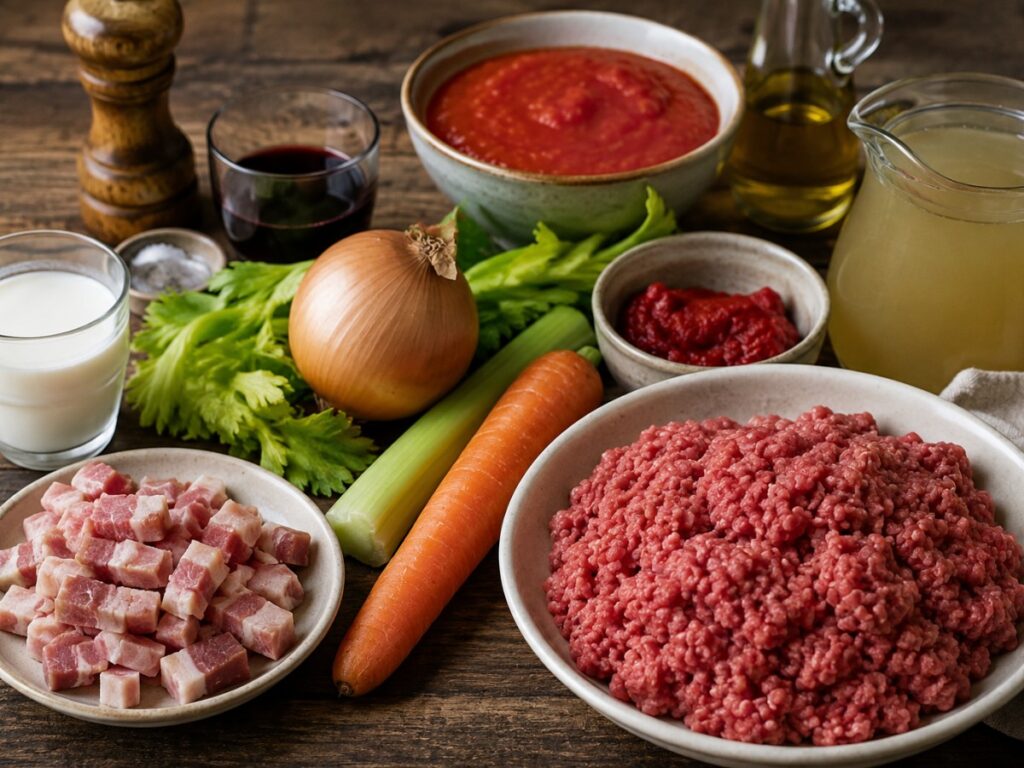
Ingredients

  • 400 g coarsely ground beef pulp
  • 150 g fresh pancetta
  • onion, carrot, and celery
  • wine (red or white)
  • tomato purée and tomato paste
  • broth
  • milk (optional)
  • extra virgin olive oil, salt, and pepper

Preparation

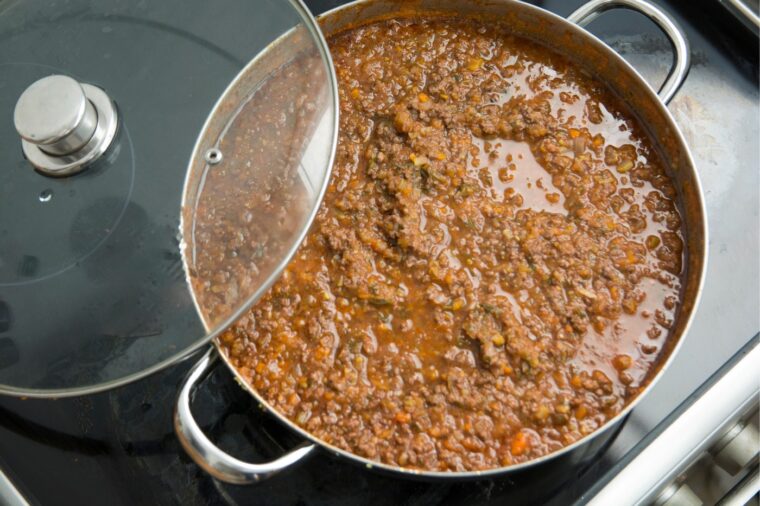
  1. Start with the base: finely chop the pancetta and vegetables; sauté them slowly until soft.
  2. Add the beef and brown it until it has released and reabsorbed its liquids.
  3. Add the wine to deglaze and deepen the flavour, allowing it to evaporate completely.
  4. Stir in the tomato and cook low and slow, for up to three hours.
  5. Halfway through cooking, milk may be added to soften the acidity and bind the flavors together.
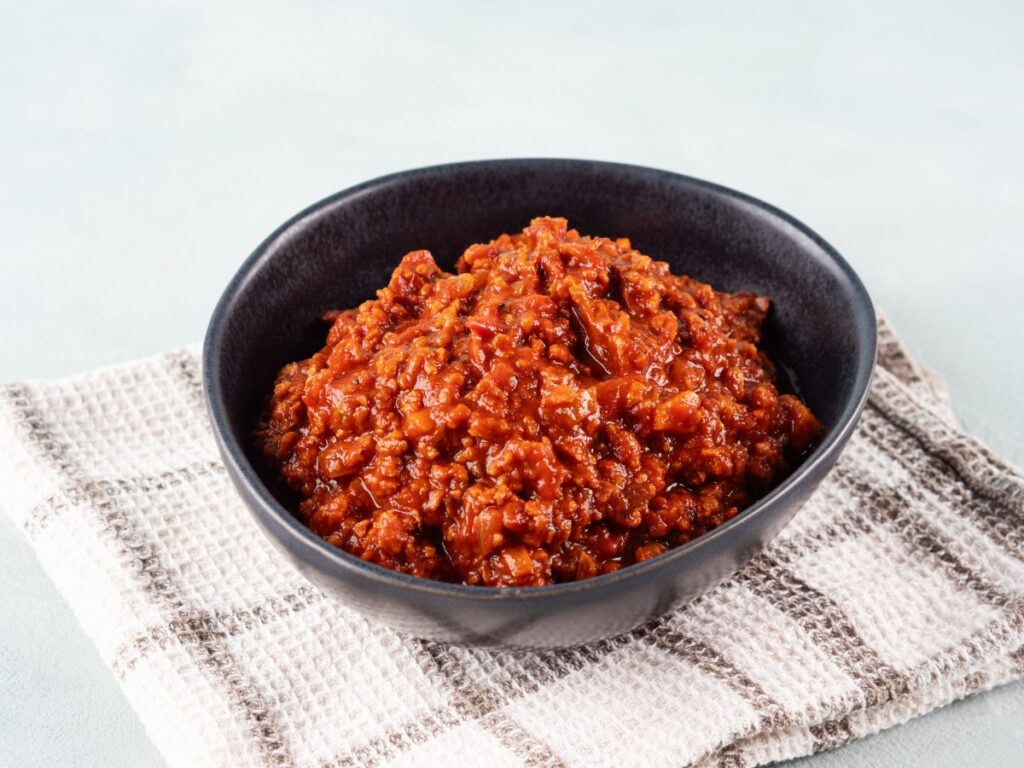
  6. The end result of the ragù should be dense, enveloping, and dark orange in color.

A Sauce That Is More Than Just a Sauce

It must be said that there is no single “perfect” recipe for ragù. Every family has its own version, every household its own balance. And yet, beyond all the differences, one element always remains constant: time. Ragù is a slow preparation, one that demands attention, but never haste.

Pignoletto dei Colli Bolognesi: The Wine That Tells Bologna’s Story Beyond the City Walls

Fresh, straightforward, and deeply rooted in its territory: Pignoletto is the white wine that cheerfully accompanies Bolognese cuisine, revealing its more convivial side. 

In Bologna, wine never arrives alone. It is accompanied by a board of cured meats, a basket of warm crescentine, a slice of freshly cut Mortadella and Parmigiano Reggiano. And most often, the wine in the glass is Pignoletto.

It lacks the international fame of Prosecco and the symbolic weight of the great Italian reds; yet, to truly understand the Bolognese table, one must also experience this lively white, which appears simple only to those who look at it on the surface.

The Territory: The Colli Bolognesi

Pignoletto originates in the hills surrounding Bologna, above all in the Colli Bolognesi. Just a few kilometers from the city center, the porticoes give way to vineyards, slopes, clay ravines, narrow country roads, and wineries that maintain a strong bond to their land. In this setting, Pignoletto finds its character: fresh, savory, and sometimes with a slightly bitter finish.

The Grape Variety and the Appellation 

The name “Pignoletto” is generally linked to the shape of the grape cluster, which is compact and resembles a small pinecone (pigna in Italian).

The base variety is Grechetto Gentile, known locally as Alionzina. The production regulations for the DOCG Colli Bolognesi Pignoletto require at least 85% Grechetto Gentile, with the remaining portion coming from other non-aromatic white grapes. The appellation is protected by the Consorzio Vini Colli Bolognesi, which also promotes the wine’s dual nature: the frizzante and sparkling versions, which are more immediate, and the still versions, which are often more structured and better at expressing the character of the territory.

A Wine That Has Evolved Over Time

For a long time Pignoletto was considered a “house wine”, the bottle opened without much ceremony, tied more to daily life than to formal tasting. Today that image has changed, not because it has lost its approachability, but because many producers have focused on quality, aromatic precision, and the balance between freshness and structure.

The result is a more refined wine that retains its convivial nature and is no longer considered a “minor”. 

The Different Styles of Pignoletto

In the glass, it can vary significantly depending on the version.

  • The Frizzante Pignoletto (semi-sparkling) is the most popular and instinctive: agile, fresh, and perfect with cured meats and fried dishes.
  • The Sparkling (Spumante) version features a more defined bubble. 
  • The Still (Fermo) version, on the other hand, is often the most interesting for those wishing to understand the territory; it is less direct, more gastronomic, and possesses a structure that can accompany first courses and cheeses.

Distinctive Traits and Pairings with Bolognese Cuisine

The common thread is that slightly bitter finish that makes Pignoletto recognizable and it should absolutely not be considered a flaw; rather, it is its signature. In a region where the cuisine tends to be rich, indulgent, and envolping, this final note helps cleanse the palate and invites another sip.

This is also why Pignoletto works so well with Bologna. Try it with mortadella, with crescentine and tigelle, but it will also surprise you alongside tortellini, tagliatelle, and stuffed pastas.

A Wine to Discover (Especially for Outsiders)

For foreigners, it is often a revelation. Many come to Bologna seeking ragù, tortellini, and Parmigiano Reggiano, but they do not immediately associate the city with an identity — defining wine like Pignoletto — a wine that reveals a Bologna that is not only “rich” and opulent, but also discreet, hilly and agricultural.

Pignoletto by the Numbers

Today, Pignoletto is a wine growing in stature as well as in figures. The Consorzio points to approximately 2,400 hectares under cultivation and 2,000 winegrowers involved in the protection and promotion of regional Pignoletto.

For the DOCG Colli Bolognesi Pignoletto specifically, the recent estimates speak of around 670 hectares of vineyards and over one million bottles produced annually.

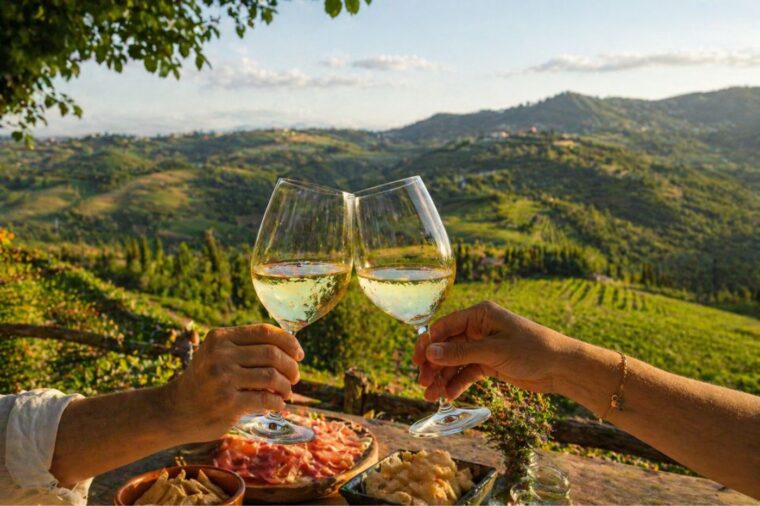
We look forward to welcoming you to share a glass of Pignoletto and a platter of cured meats. We can do so on one of our tours in a traditional bottega in the city center, or on a hillside at sunset, when Bologna is close enough to feel and far enough to see it better.

Mortadella Bologna: The “Pink Queen” and its Irresistible Appeal

The History, craft and allure of one of Emilia-Romagna’s culinary icon

In Bologna, the local cuisine is characterized by aromas that linger in the memory longer than images.

One of these is the scent of freshly sliced Mortadella in the city’s historic food shops, cut so thin it’s almost translucent. Its aroma is so delicate and lightly spiced that, together with its unmistakable pink hue, makes you want to reach out and taste it right then and there.

For many foreign visitors, it is a surprising discovery. They arrive with a generic idea of “mortadella,” often associated with industrial products, but when they taste the original version, they immediately realize it is an entirely different story.

A Cured Meat Born Before the Middle Ages

Mortadella is neither a recent invention nor a product of popular cuisine as we typically imagine it. Its origins date back to Ancient Rome, when pork was already being finely processed in mortars – from which, most likely, its name derives.

But it was in the Middle Ages that Bologna turned it into a symbol. The city, wealthy and well-organized, regulated its food trade with precision. In 1661, the Bolognese Senate established specific rules for the production of mortadella, a sort of early quality control standards that show how important, high-quality, and recognizable this product already was back then.

How Mortadella di Bologna Is Made

The difference between authentic mortadella and any imitation becomes clear from the very first bite, but its distinctive qualities actually take shape much earlier, that is, during the production process itself.

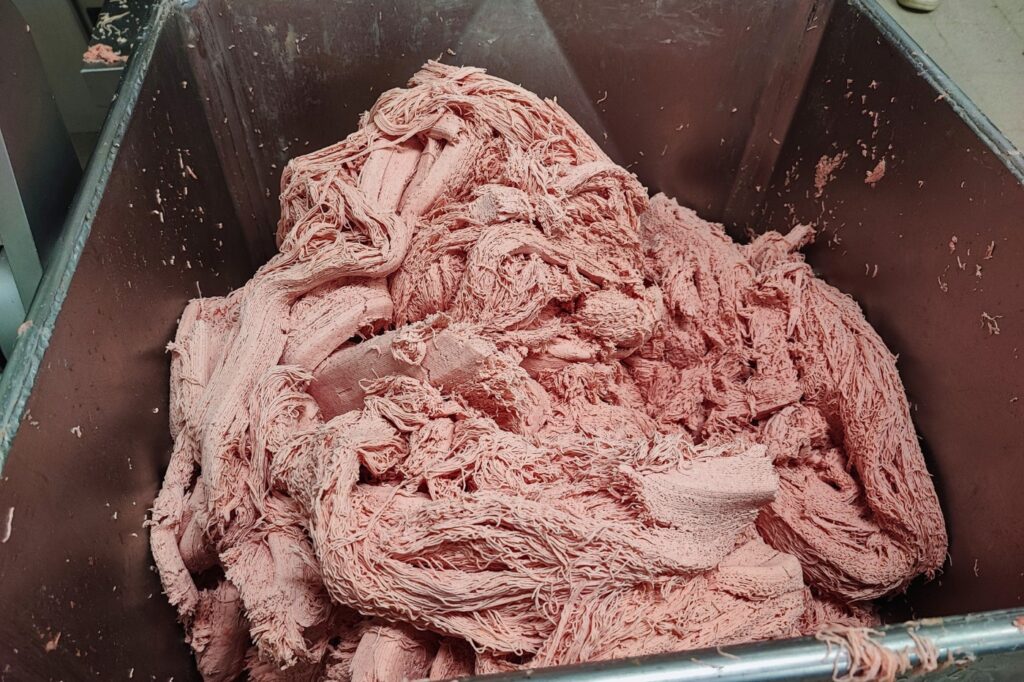
The pork meat is processed until it becomes an extremely fine, almost creamy mass. It is not a simple grinding; it’s an emulsion that requires precision and careful temperature control. To this base are added cubes of pork fat (lardelli), clearly visible in the slice, and a carefully balanced blend of spices.

Mortadella meat finely emulsified before seasoning and cooking (Photo © BFEX).

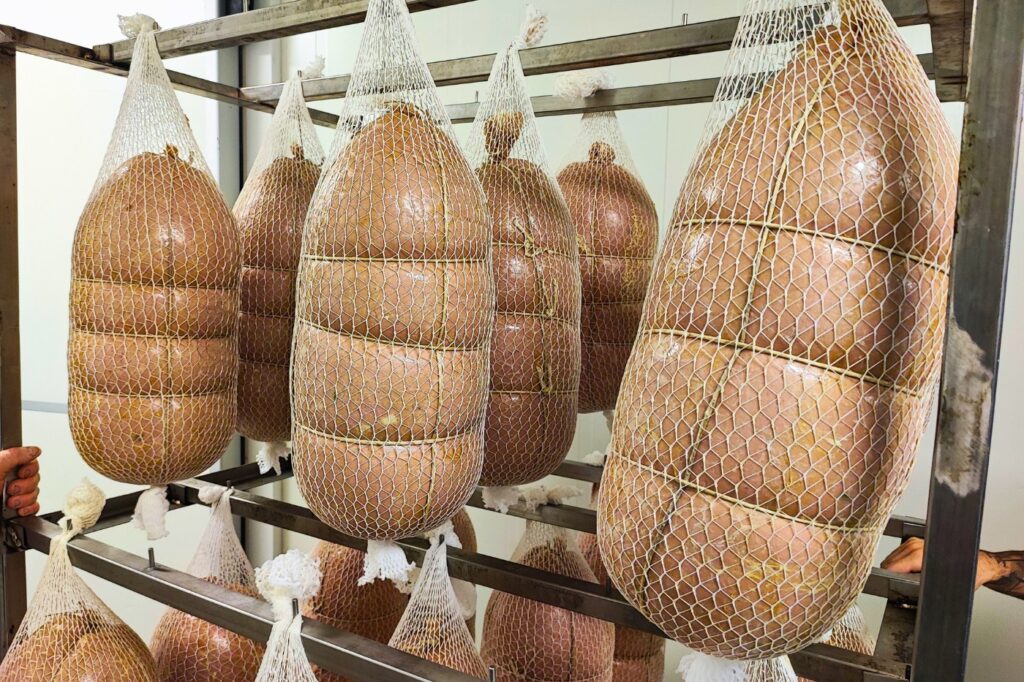
The cooking process is slow and gradual, carried out in dry-air ovens. This is where balance is struck: too much heat would ruin the structure, while too little would prevent the aromas from developing. The result is a velvety consistency — firm but not rubbery —  with an elegant fragrance. It is a product of only apparent simplicity, built upon a refined technique.

Mortadella ready for slow cooking and maturation (Photo © BFEX).

The Real Thing Is Not What You Imagine

One of the most striking aspects, especially for international visitors, is the contrast between authentic Mortadella di Bologna and the products bearing its name outside Italy. 

In the United States, for example, “bologna” has become a generic term for an inexpensive deli meat, often smoked, with a completely different texture and taste. The original version, on the other hand, is not smoked, not aggressive in flavor, and not overly salty. It has a natural sweetness and aromatic clarity that wins over anyone tasting it for the first time. 

Even the pistachio, frequently considered a traditional ingredient, is actually a modern variation, absent from the historical recipes.

A Certified Excellence Protecting the Consumer

Today, Mortadella di Bologna IGP is protected by the European Union under the Protected Geographical Indication (PGI) mark, a recognition that guarantees its origin and adherence to strict production standards. 

To obtain certification, the mortadella must be made from selected meats, follow codified processing techniques, and pass rigorous controls throughout the entire supply chain. Production is not limited exclusively to the city of Bologna, but extends to specific areas of Emilia-Romagna and neighboring regions historically tied to this tradition.

This regulatory system serves as a concrete guarantee of quality and authenticity, designed to protect consumers also from imitations that are especially widespread in international markets.

A Cultural Icon That Speaks to the World

Mortadella Bologna IGP is today one of Italy’s most exported cured meats. More than 160,000 tonnes are produced annually, with nearly half of that volume destined for foreign markets. 

The United States remains a key market, alongside Germany and France. In recent years, interest has also grown in Asia, where the appeal of Made in Italy is increasingly linked to the authenticity of the products.

How to Eat It in Bologna 

To truly understand mortadella, you have to think beyond the “quick sandwich.” In Bologna, it is served thinly sliced, often with the slicer set to its thinnest setting. The slice should almost fold on itself and melt in your mouth. It is paired with simple bread or warm crescentine, which bring out its softness.

And then there is the wine: a glass of Pignoletto, fresh and lightly aromatic, is the most natural pairing for mortadella. 

Mortadella is one of those products that tells the story of the city’s culinary soul, its everyday habits, its craftsmanship and method. Enjoy it in a traditional bottega, watch it being sliced, catch its aroma, and listen to the stories of those who make it.